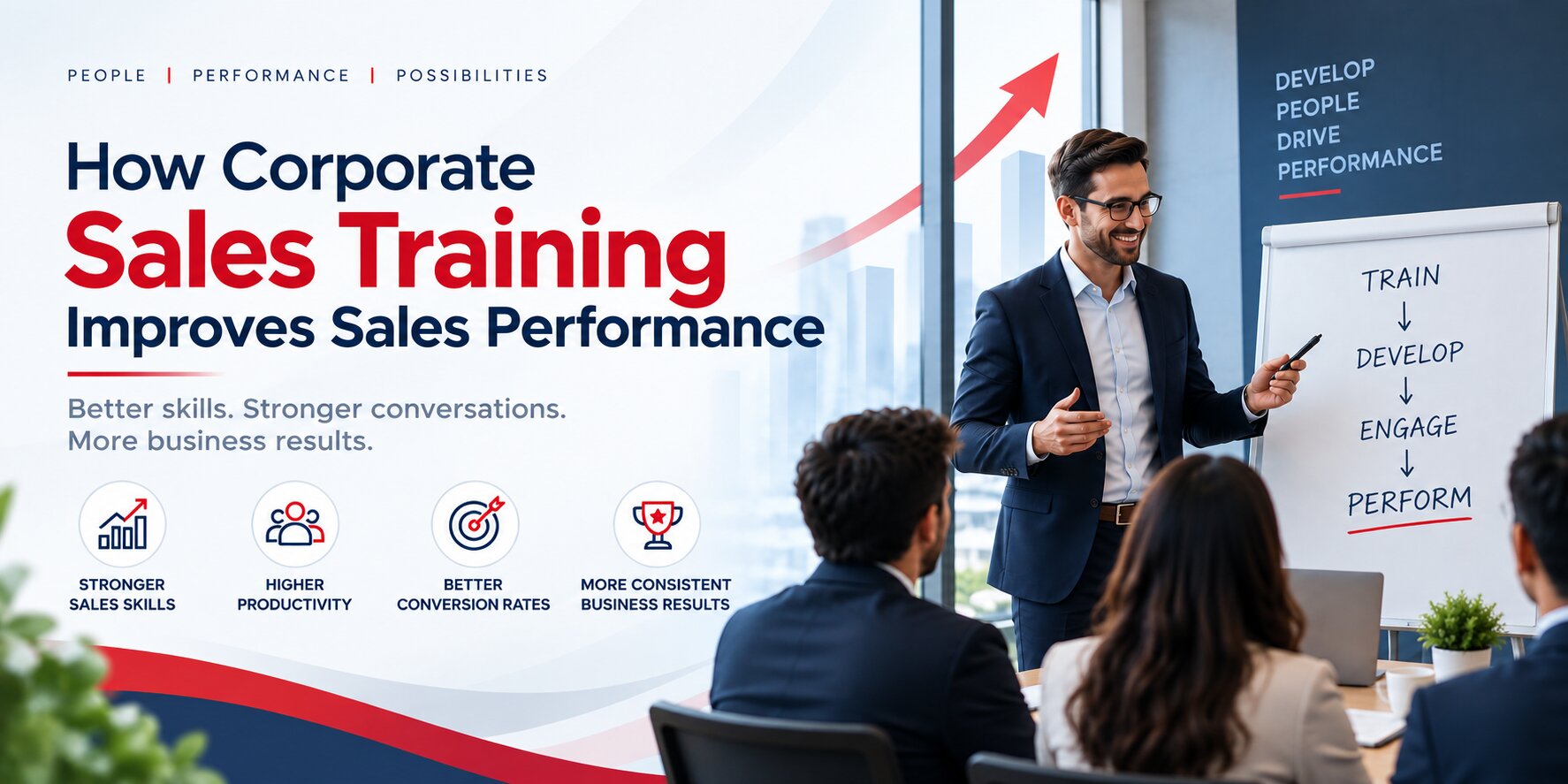
How Corporate Sales Training Improves Sales Performance
Sales performance rarely improves simply because a company hires more salespeople or sets higher targets. Consistent results come from having people who understand the sales process, communicate value clearly, handle objections confidently, and know how to move opportunities forward. This is where Sales Performance Improvement Training can make a measurable difference. Well-designed corporate sales training connects individual capabilities with business objectives, helping sales teams turn better skills and behaviors into stronger commercial outcomes.
What Is Corporate Sales Training?
Corporate sales training is a structured approach to developing the knowledge, skills, and behaviors sales professionals need to perform effectively. Unlike one-time motivational sessions, effective training focuses on practical selling capabilities and reinforces them through application, coaching, feedback, and measurement.
Depending on the organization, training may cover prospecting, consultative selling, discovery conversations, questioning techniques, negotiation, objection handling, presentation skills, account management, closing, and customer relationship management. The objective is not simply to teach salespeople what to do but to help them consistently apply the right behaviors in real customer situations.
How Sales Training Improves Performance
The connection between training and performance becomes clearer when we look at what happens during the sales process. A salesperson may have a strong product but still struggle to identify customer needs, qualify opportunities, communicate business value, or manage objections. Training addresses these gaps systematically.
Effective sales training and performance improvement usually happens through several mechanisms:
- Better sales conversations: Salespeople learn how to ask relevant questions, listen actively, and connect solutions to customer priorities.
- Improved opportunity qualification: Teams become better at distinguishing genuine opportunities from prospects that are unlikely to convert.
- Stronger objection handling: Structured techniques help salespeople respond to concerns without becoming defensive or immediately discounting.
- More consistent sales processes: Teams develop common approaches to prospecting, discovery, follow-up, negotiation, and closing.
- Greater confidence: Repeated practice and feedback make critical sales behaviors more reliable under pressure.
Over time, these improvements can contribute to higher conversion rates, better pipeline quality, shorter sales cycles, and more predictable revenue performance.
Key Benefits of Corporate Sales Training
The sales training benefits extend beyond individual salesperson capability. When training is aligned with the company's sales strategy, it can improve how the entire team operates.
One major benefit is consistency. Without a common framework, every salesperson may approach customers differently. This makes performance difficult to manage and creates uneven customer experiences. Training establishes shared expectations around sales behaviors and processes.
Another benefit is faster development. New salespeople can take considerable time to understand products, customers, processes, and selling techniques. A structured development approach can reduce the learning curve by giving them clear frameworks and opportunities to practice.
Training can also support managers. When managers understand the same sales methodology as their teams, coaching becomes more specific. Instead of saying “close more deals,” a manager can identify whether the salesperson needs to improve discovery, qualification, value communication, negotiation, or follow-up.
Developing Sales Skills That Actually Matter
Sales skills development should focus on behaviors that influence customer decisions rather than simply providing theoretical knowledge. A salesperson may understand a selling technique in a classroom but fail to use it during an actual customer meeting.
That is why practical learning matters. Role plays, case studies, simulated negotiations, call reviews, peer feedback, and manager coaching allow employees to practice skills before applying them in live situations.
For example, instead of only explaining objection handling, training can simulate a customer questioning price, comparing competitors, or delaying a purchase decision. The salesperson can then practice responding, receive feedback, and try again. This creates a much stronger connection between learning and workplace behavior.
How Training Supports Sales Effectiveness and Productivity
Sales effectiveness is about how efficiently and consistently a sales team converts opportunities into business results. Training can improve effectiveness by helping salespeople spend more time on qualified opportunities and use better approaches during each stage of the buying process.
It can also influence sales team productivity. Productivity is not simply about making more calls or sending more emails. A salesperson who contacts 100 poorly qualified prospects may be less productive than someone who engages 30 well-qualified prospects with relevant conversations.
Effective training therefore focuses on both activity and quality. Teams learn how to prioritize accounts, prepare for customer meetings, conduct better discovery, follow up with purpose, and maintain disciplined pipeline management.
Measuring Sales Performance Improvement
Training should not be evaluated only through attendance, participant satisfaction, or test scores. Organizations need to determine whether learning is changing behavior and contributing to business outcomes.
Relevant sales performance metrics may include:
- Lead-to-opportunity conversion rate
- Opportunity-to-customer conversion rate
- Win rate
- Average deal value
- Sales-cycle length
- Quota attainment
- Pipeline coverage
- Revenue per salesperson
- Customer retention and expansion
These metrics should be examined before and after training where possible. However, organizations should avoid assuming that every performance change is caused by training alone. Pricing, market conditions, product changes, lead quality, territory design, and sales management can also influence results.
Why Ongoing Training Is More Effective Than One-Time Training
The impact of sales training on sales performance is more likely to last when learning continues after the classroom or workshop ends. Salespeople need opportunities to apply new skills, receive feedback, and correct mistakes.
This is where managers play an important role. Regular coaching conversations, pipeline reviews, call observations, role plays, and targeted development plans can reinforce the behaviors introduced through training.
Organizations should also revisit training as their market changes. Customer expectations, buying processes, technology, competitors, and sales channels evolve. A training program that was effective several years ago may not address today's selling environment.
How to Improve Sales Team Performance Through Training
Companies looking at how to improve sales team performance should begin by identifying the actual capability gaps rather than selecting generic training topics. Start with performance data, manager observations, customer feedback, sales-call analysis, and input from salespeople.
Next, connect those gaps to specific behaviors. If conversion rates are weak, the issue may involve qualification or discovery rather than closing. If deal values are low, salespeople may need stronger value communication or negotiation skills. If sales cycles are long, opportunity management and stakeholder engagement may require attention.
Finally, establish a measurement plan before training begins. Define the behaviors that should change, the metrics that will indicate progress, and how managers will reinforce the learning. This makes training a business intervention rather than an isolated learning event.
Conclusion
Corporate sales training works best when it is treated as part of a broader performance system. The real objective is not to make salespeople attend more training sessions; it is to help them perform critical sales behaviors more effectively and consistently.
For organizations focused on sustainable sales performance improvement, training should combine practical skill development, coaching, measurement, and continuous reinforcement. When these elements work together, sales teams are better equipped to create meaningful customer conversations, manage opportunities effectively, and deliver more predictable business results.
The People 1st takes a performance-focused approach to capability development, helping organizations connect sales skills with measurable workplace outcomes. If your goal is to build stronger and more consistent sales capabilities, Sales Performance Improvement Training can be integrated into a structured development approach rather than treated as a one-off intervention.