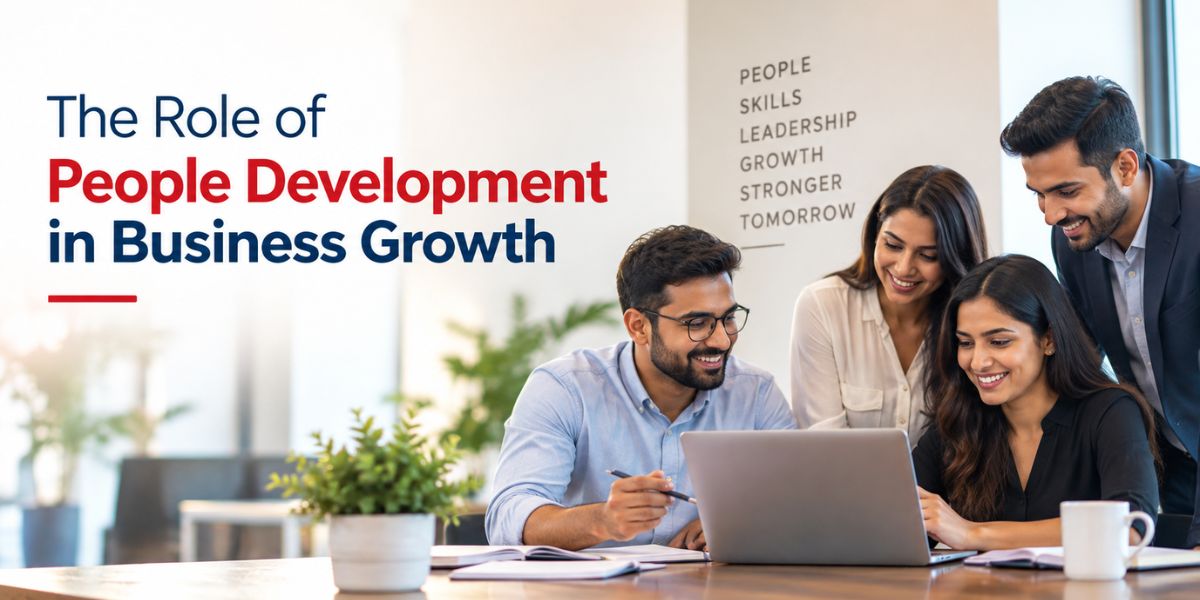
The Role of People Development in Business Growth
Business growth is often associated with revenue, customers, technology, and market expansion. Yet behind each of these areas are people who make decisions, solve problems, serve customers, manage teams, and execute business strategies.
That is why people development and business growth are closely connected. A business can invest in new technology or enter new markets, but sustainable growth becomes difficult when employees do not have the skills, confidence, leadership ability, or knowledge needed to support that growth.
A well planned people development approach helps organisations build stronger capabilities while preparing employees for changing responsibilities. Research also connects employee development and training with outcomes such as productivity, retention, and organisational performance.
Businesses looking to strengthen their leadership capabilities can also explore a Best Leadership Development Program for Managers as part of a broader approach to developing people and future leaders.
What Is People Development?
What is people's development? In simple terms, people development is the ongoing process of helping employees improve their knowledge, skills, behaviours, capabilities, and confidence so they can perform effectively and take on greater responsibilities.
People development can include:
- Leadership development
- Skills training
- Coaching and mentoring
- Performance feedback
- Career development
- Knowledge sharing
- Stretch assignments
- Succession planning
- Communication development
- Role specific learning
The purpose is not simply to provide employees with training sessions. A meaningful people development strategy connects individual growth with the capabilities the organisation needs to achieve its goals.
Why Is People Development Important for Businesses?
The importance of people development becomes clearer when businesses start connecting employee capabilities with operational results.
Employees who understand their roles, have the right skills, and receive opportunities to develop can contribute more effectively to organisational goals. Development can also help organisations identify capability gaps before they become larger performance problems.
A business that is expanding, for example, may suddenly need more managers who can lead larger teams. A company entering a new market may need employees with stronger communication and market knowledge. A growing sales function may need leaders who can coach teams instead of simply monitoring targets.
People development helps prepare employees for these changing requirements.
How Employee Development Drives Business Growth
Understanding how employee development drives business growth requires looking beyond training completion numbers.
Employee development can influence business growth through several areas.
1. Improving Employee Skills
Employees need relevant skills to perform effectively as business requirements change. Training and development can help close capability gaps and improve the way employees approach their responsibilities.
Recent research published in the British Journal of Industrial Relations examined 19,289 firm year observations and found that greater investment in training was associated with higher labour productivity for managers and staff.
2. Developing Better Leaders
Business growth often creates new leadership requirements. Employees who were successful as individual contributors may need completely different capabilities when they become managers.
Leadership development can help managers improve communication, delegation, decision making, feedback, team development, and performance management.
3. Supporting Employee Retention
The benefits of employee development can also extend to retention. Employees may be more likely to see a future within an organisation when they have opportunities to learn, develop, and take on new responsibilities.
Development should not be viewed as a guaranteed solution to employee turnover because retention is influenced by many factors. It can nevertheless form an important part of a broader employee experience and talent strategy.
4. Building Organisational Capability
A business becomes more capable when its employees become more capable.
Development can create a stronger internal talent pool, helping organisations reduce dependence on hiring externally for every new responsibility. Employees who understand the organisation and develop new capabilities can potentially move into higher responsibility roles as the business evolves.
Employee Development and Business Performance
The relationship between employee development and business performance becomes meaningful when development is connected to measurable business needs.
A common mistake is to measure development only through attendance or course completion. Those numbers can show participation, but they do not necessarily demonstrate business impact.
A stronger measurement approach can include:
- Productivity
- Quality of work
- Customer satisfaction
- Employee retention
- Internal promotions
- Sales performance
- Manager effectiveness
- Achievement of role specific goals
SHRM recommends connecting learning outcomes with business KPIs such as revenue growth, customer satisfaction, and operational efficiency so organisations can understand whether development initiatives are contributing to business objectives.
What Are the Benefits of Employee Development?
The benefits of employee development can differ depending on the organisation, workforce, and development objectives. Common benefits include:
- Stronger job related skills
- Better leadership capability
- Greater employee confidence
- Improved internal mobility
- Stronger succession readiness
- Better adaptation to organisational change
- More consistent performance
- Greater alignment between employee capabilities and business goals
The impact can also extend across teams. Gallup's meta analysis of strengths based development research examined 43 studies covering 1.2 million employees and found relationships between strengths based development and outcomes including employee engagement, sales, profit, customer engagement, and turnover.
These findings should not be interpreted as meaning every development initiative will automatically produce the same business results. The design, implementation, organisational context, and quality of management all influence outcomes.
How to Develop Employees for Business Growth
Knowing how to develop employees for business growth starts with understanding what the organisation is trying to achieve.
A practical process can include the following steps.
Identify Future Business Requirements
Start by identifying where the business wants to go. Expansion, new technology, changing customer expectations, and new products can all create new capability requirements.
Identify Current Skill Gaps
Compare the capabilities required for future goals with the capabilities currently available within the organisation.
Create Individual Development Plans
Employees do not necessarily need the same development path. Development plans can be based on current responsibilities, career aspirations, performance gaps, and future business requirements.
Combine Different Development Methods
Learning can take different forms. Formal training, coaching, mentoring, practical assignments, peer learning, and leadership development can all contribute to employee growth.
Measure Business Outcomes
Track whether development is influencing the areas that matter to the organisation. The goal should be to understand what changed after development, not simply how many people attended a session.
Building a People Development Strategy for Business Growth
A people development strategy for business growth should be connected to the organisation's wider business strategy.
Consider a company planning to double its workforce. Its people development priorities may include manager development, communication, delegation, recruitment capability, onboarding, and succession planning.
Another organisation may be focused on improving customer experience. Its development priorities could include customer communication, problem solving, product knowledge, service leadership, and performance coaching.
The strategy therefore needs to answer three basic questions:
- What does the business want to achieve?
- What capabilities will employees need to achieve it?
- How will the organisation develop and measure those capabilities?
This approach prevents people development from becoming a disconnected HR activity. Instead, it becomes part of how the organisation prepares its workforce for future business requirements. Current research also highlights the importance of aligning development with business performance rather than treating learning as an isolated activity.
The Role of Managers in People Development
Managers have a significant influence on whether development becomes part of everyday work.
An employee may attend an excellent training session, but without opportunities to practise new skills, receive feedback, and apply what they have learned, the impact may be limited.
Managers can support development by:
- Holding regular development conversations
- Providing specific feedback
- Setting meaningful goals
- Giving employees opportunities to take on new responsibilities
- Identifying capability gaps
- Supporting learning through day to day work
- Recognising progress
This is also why leadership development is closely connected to people development. Managers are not only responsible for business results. They also influence how employees learn, perform, collaborate, and grow.
People Development Is a Business Growth Strategy
The role of employee development in business growth is ultimately about building the capabilities required to execute business strategy.
Growth creates new challenges. Teams become larger, responsibilities change, customer expectations evolve, and managers need to make more complex decisions. Organisations that continuously develop their people are better positioned to build the capabilities required for those changes.
The People 1st approaches people development as an important part of organisational capability, helping businesses think beyond individual training sessions and focus on the skills and leadership capabilities needed for sustainable performance.
Businesses can also explore Corporate Leadership Development Programs in India when leadership capability is a key part of their people development priorities.
Final Thoughts
The importance of employee development goes beyond improving individual performance. People development can help organisations build stronger leaders, close capability gaps, support internal growth, improve productivity, and prepare employees for changing business requirements.
A successful approach does not treat development as an occasional training activity. It connects employee growth with business objectives and measures whether new capabilities are making a meaningful difference.
The organisations that understand this connection can make people development part of their broader growth strategy rather than treating it as a separate HR responsibility.