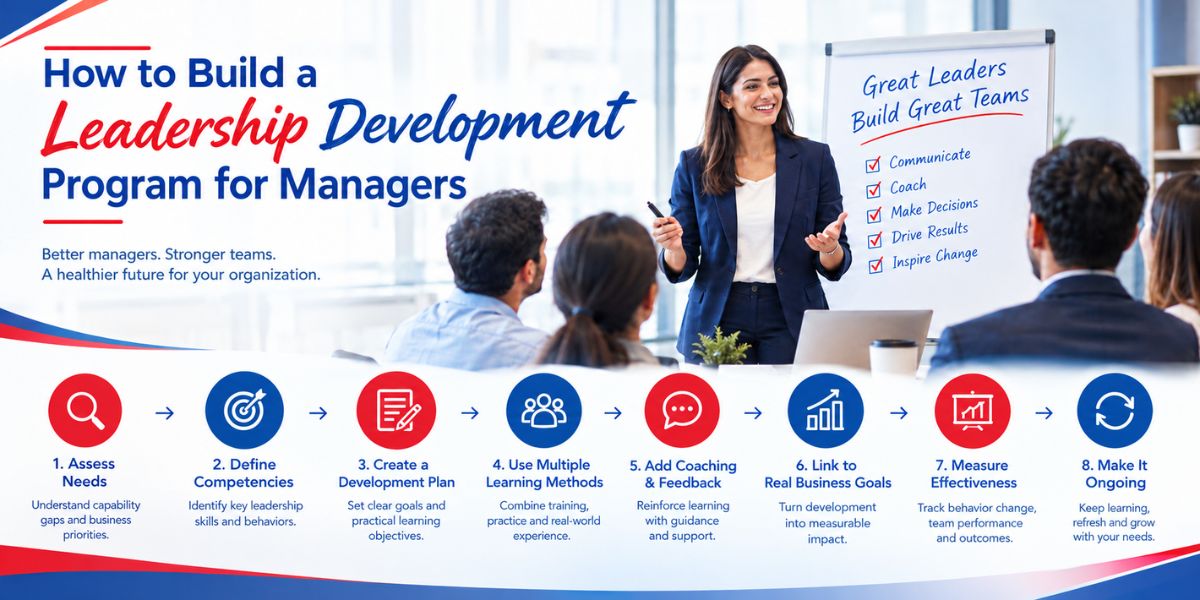
How to Build a Leadership Development Program for Managers
Promoting a high-performing employee into management does not automatically make that person an effective leader. Managers are expected to set direction, make decisions, coach employees, manage performance, resolve conflicts, and connect team priorities with business goals. Without structured development, many managers learn these responsibilities through trial and error. A well-designed best leadership development programme for managers can give managers the capabilities, practice, and feedback they need to lead with greater consistency and confidence.
Why Leadership Development for Managers Matters
Managers occupy a critical position between organisational strategy and day-to-day execution. Senior leaders may define business objectives, but managers translate those objectives into priorities, decisions, processes, and team behaviours.
Effective leadership development for managers therefore goes beyond teaching generic leadership concepts. It should address the practical challenges managers face, including delegation, communication, coaching, decision-making, accountability, conflict management, and employee development.
A strong development approach also recognises that managers at different levels have different needs. A first-time manager may need foundational people-management skills, while an experienced manager may need capabilities related to strategic thinking, organisational influence, or leading through change.
1. Start With a Leadership Development Needs Assessment
The first step in how to build a leadership development programme is understanding the actual capability gaps within the organisation. Starting with a generic list of leadership topics can result in training that sounds useful but does not address real performance problems.
A leadership development needs assessment can combine several sources of information, such as:
- Manager and employee surveys
- Performance review data
- 360-degree feedback
- Employee engagement results
- Interviews with senior leaders
- Observation of management behaviours
- Business and team performance metrics
The goal is to identify where managers are struggling and which capabilities have the greatest connection to business priorities.
2. Define the Leadership Competencies Managers Need
Once capability gaps are identified, define the specific leadership competencies for managers that the program should develop. Competencies should describe observable behaviors, not vague qualities such as “be a better leader.”
Depending on the organisation's context, important competencies may include:
- Strategic and critical thinking
- Communication and active listening
- Decision-making
- Delegation and accountability
- Coaching and feedback
- Conflict management
- Emotional and social awareness
- Change leadership
- Performance management
- Collaboration and stakeholder management
Defining these competencies creates a clear framework for designing learning activities and evaluating progress.
3. Create a Leadership Development Plan for Managers
A leadership development plan for managers should translate competencies into specific learning objectives and development activities. Each objective should answer a practical question: what should the manager be able to do differently after completing the development process?
For example, instead of setting an objective such as “understand coaching", a stronger objective would be “conduct structured coaching conversations that help employees identify performance barriers and agree on specific actions.”
This approach makes development measurable and gives managers a clear connection between learning and their everyday responsibilities.
4. Use Multiple Learning Methods
Manager development should not depend entirely on classroom sessions or online courses. Leadership capabilities are behavioural, which means managers need opportunities to practise them.
An effective programme can combine workshops with case studies, role plays, simulations, peer learning, action-learning projects, manager coaching, self-reflection, and workplace assignments. For example, a manager learning delegation could practise assigning a real project, clarify expectations with the employee, and later review what worked and what did not.
This practical approach makes manager leadership development more relevant because participants immediately connect concepts with situations they encounter at work.
5. Build Coaching and Feedback Into the Program
One of the most important elements of leadership development for managers is reinforcement. A manager may understand a leadership technique during a workshop but fail to use it consistently when dealing with real employees and business pressure.
Regular coaching helps close this gap. Managers can discuss specific situations with their leaders or coaches, receive feedback, test alternative approaches, and reflect on outcomes. Peer learning can also be valuable because managers often encounter similar challenges in different parts of an organisation.
Feedback should focus on observable behaviour and its impact. Instead of simply telling a manager to “communicate better", feedback should identify what happened, how it affected the team, and what behaviour could produce a better outcome.
6. Connect Development With Real Business Challenges
A leadership programme becomes more valuable when participants apply their learning to actual organisational priorities. Action-learning projects can ask managers to solve a genuine business problem while demonstrating specific leadership competencies.
For example, managers might work on improving team productivity, reducing employee turnover, strengthening cross-functional collaboration, or improving customer experience. This allows development to happen alongside business improvement rather than separately from it.
7. Measure Leadership Development Program Effectiveness
Leadership development program effectiveness should be evaluated at multiple levels. Simply measuring attendance or participant satisfaction does not demonstrate that managers have become more capable.
Organizations can examine:
- Changes in leadership competency assessments
- 360-degree feedback before and after development
- Employee engagement or team climate indicators
- Quality and frequency of manager coaching conversations
- Internal promotion and succession readiness
- Team performance indicators
- Retention and absenteeism trends where relevant
Not every business outcome can be attributed directly to leadership development. Market conditions, organizational changes, compensation, workload, and other factors can influence results. Therefore, evaluation should combine behavioural evidence with relevant business indicators rather than relying on a single metric.
8. Treat Leadership Development as an Ongoing Process
The strongest leadership development programme for managers is not a one-time event. Leadership capabilities develop through repeated practice, reflection, feedback, and increasingly complex responsibilities.
Organisations should periodically review competency frameworks, gather feedback from managers and employees, assess programme outcomes, and update learning priorities. As the organization grows or its strategy changes, managers may need new capabilities.
Conclusion
Building an effective manager development program requires more than selecting leadership topics and scheduling workshops. It starts with identifying real capability gaps, defining observable competencies, creating relevant development plans, providing practical learning opportunities, and reinforcing new behaviors through coaching and feedback.
Organisations that approach how to develop effective managers as a continuous capability-building process are better positioned to create stronger teams and a more reliable leadership pipeline. The objective is not to create managers who follow a fixed leadership formula but to develop people who can adapt their leadership approach to different employees, situations, and business challenges.
The People 1st focuses on structured capability development that connects leadership learning with workplace performance. For organisations looking to strengthen their managers and build a sustainable leadership pipeline, a Best Leadership Development Program for Managers should be practical, measurable, and aligned with the organisation's actual leadership requirements.