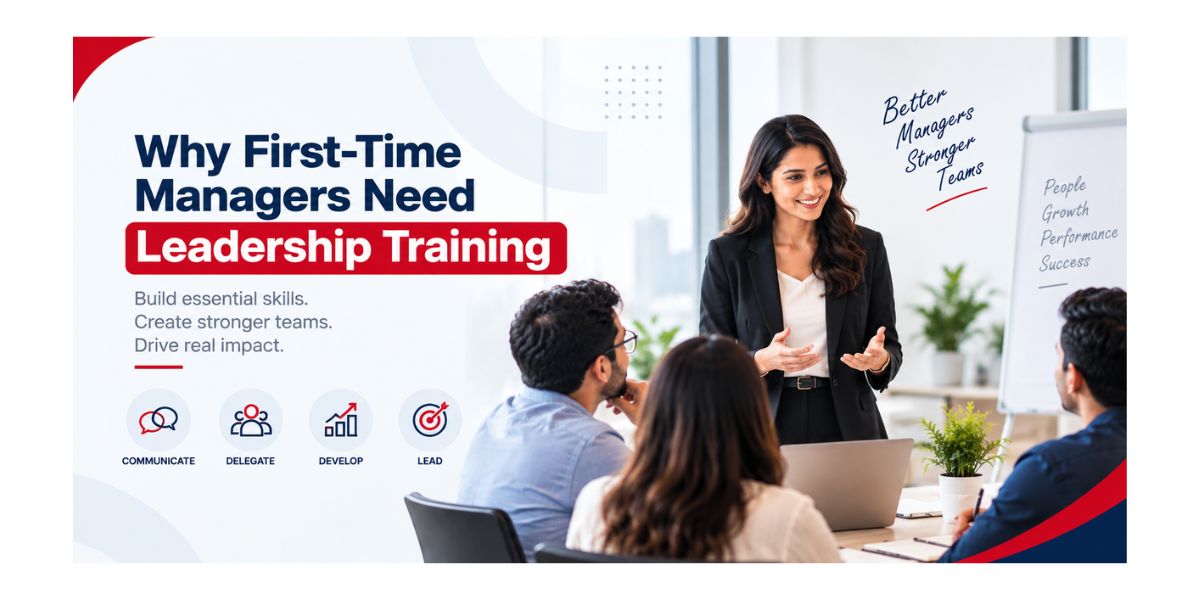
Why First-Time Managers Need Leadership Training
Becoming a manager for the first time is a significant shift in responsibility. A high-performing employee may understand the company's processes, deliver strong individual results, and have excellent technical expertise, but managing people requires a different set of capabilities. Leadership Skills Training for Managers can help new managers make this transition more effectively by developing the skills needed to communicate, delegate, coach, make decisions, and manage performance.
Why the Transition to Management Is Difficult
The transition from individual contributor to manager changes how success is measured. As an individual contributor, performance is largely connected to personal output. As a manager, results depend increasingly on how effectively you enable other people to perform.
This shift can be uncomfortable. A newly promoted manager may still want to solve every problem personally, avoid difficult conversations, or continue using the same working style that made them successful as an individual contributor. Those behaviours can become limitations when the role requires delegation, accountability, and team development.
This is one reason first-time manager training should happen early rather than after problems have already developed.
Common Challenges Faced by First-Time Managers
The challenges faced by first-time managers are often less about technical knowledge and more about people and organisational dynamics. Common challenges include:
- Delegating work without micromanaging
- Giving constructive feedback
- Managing former peers
- Handling disagreements and conflict
- Setting clear expectations
- Managing underperformance
- Balancing team needs with business priorities
- Making decisions with incomplete information
- Motivating employees with different needs
Without guidance, new managers may rely on trial and error. While experience is important, organisations should not assume that every manager needs to make avoidable mistakes before learning fundamental management practices.
Leadership Skills for New Managers
The leadership skills for new managers are different from simply being good at a technical or functional role. New managers need to develop capabilities that help them create clarity, build trust, and improve team performance.
Communication is one of the most important. Managers need to communicate expectations clearly, listen to employees, explain decisions, and adapt their communication to different situations.
Delegation is equally important. Effective delegation is not simply assigning tasks. Managers need to select the right person, explain the expected outcome, establish appropriate boundaries, and provide support without taking ownership of the work away from the employee.
Coaching and feedback are also essential. Managers should be able to identify performance gaps, discuss them objectively, and help employees determine practical actions for improvement.
Key Skills First-Time Managers Need
The skills first-time managers need should be connected directly to their responsibilities. A practical development framework may include:
- Goal setting and expectation management
- Delegation and workload planning
- Coaching and employee development
- Performance conversations
- Conflict resolution
- Decision-making and problem-solving
- Emotional self-awareness
- Stakeholder communication
- Team motivation and engagement
- Time and priority management
These capabilities do not develop simply by reading leadership theories. Managers need opportunities to practise them, receive feedback, and apply them to real workplace situations.
How First-Time Manager Training Helps
The purpose of first-time manager training should not be to provide a collection of management techniques that managers memorise. Good development focuses on changing workplace behaviours.
For example, a workshop on feedback can introduce a structured conversation model, but managers should also practise delivering feedback through realistic scenarios. Similarly, a session on delegation becomes more useful when participants apply the framework to an actual project or responsibility they need to delegate.
Role plays, case studies, simulations, peer discussions, reflection exercises, and manager coaching can make learning more practical. These methods allow new managers to experiment in a controlled environment before handling difficult conversations in real situations.
Developing New Manager Leadership Skills
New manager leadership skills develop over time. A single training session may introduce important concepts, but sustained improvement requires reinforcement.
Managers should have regular opportunities to discuss challenges with their own leaders, coaches, or peers. Reviewing difficult conversations, analysing team situations, and receiving specific feedback can help managers understand where their approach is working and where it needs adjustment.
This is particularly important because effective management is situational. The approach that works with an experienced employee may not work with a new employee. Similarly, a performance issue may require a different response from a conflict between two team members.
How to Become an Effective First-Time Manager
Anyone considering how to become an effective first-time manager should start by recognising that management is a capability that must be developed, not simply a title that comes with promotion.
New managers should focus on listening before making assumptions, setting expectations early, delegating appropriately, giving timely feedback, and holding people accountable fairly. They should also learn to distinguish between supporting employees and solving every problem for them.
Perhaps most importantly, new managers need to understand that their role is no longer measured only by what they personally accomplish. Their effectiveness is increasingly reflected in the performance, development, and health of the team they lead.
The Role of New Manager Development
New manager development works best when organisations treat it as an ongoing process rather than a one-time event. Formal learning can establish foundational knowledge, while coaching, feedback, peer learning, and workplace assignments reinforce those capabilities.
Organisations can also use manager competency frameworks to define what effective management looks like at different levels. This creates clearer expectations for new managers and gives leaders a consistent basis for development and performance discussions.
It is also useful to evaluate development through observable behaviours rather than relying only on participant satisfaction. Improvements in delegation, communication, coaching quality, employee feedback, and team performance can provide stronger evidence that development is translating into the workplace.
Why Leadership Training Should Start Early
The question of why first-time managers need training ultimately comes down to risk and capability. New managers influence employee experience, team performance, communication, and execution from the moment they take responsibility for a team.
Giving them structured development early can help prevent poor management habits from becoming established. It also signals that management is a professional responsibility that requires preparation and continuous learning.
Conclusion
First-time managers are not automatically prepared for leadership simply because they were successful in their previous roles. The move from individual contribution to people management requires a fundamental change in skills, mindset, and behaviour.
Organisations that invest in structured development can help new managers become better communicators, coaches, decision-makers, and team leaders. The goal is not to create managers who follow a rigid leadership formula but to give them the judgement and practical capabilities needed to handle different people and workplace situations effectively.
The People 1st focuses on developing practical leadership capabilities that can be applied in real organizational settings. For organizations looking to strengthen their new managers, Leadership Skills Training for Managers can provide a structured foundation for building capable, accountable, and effective leaders.