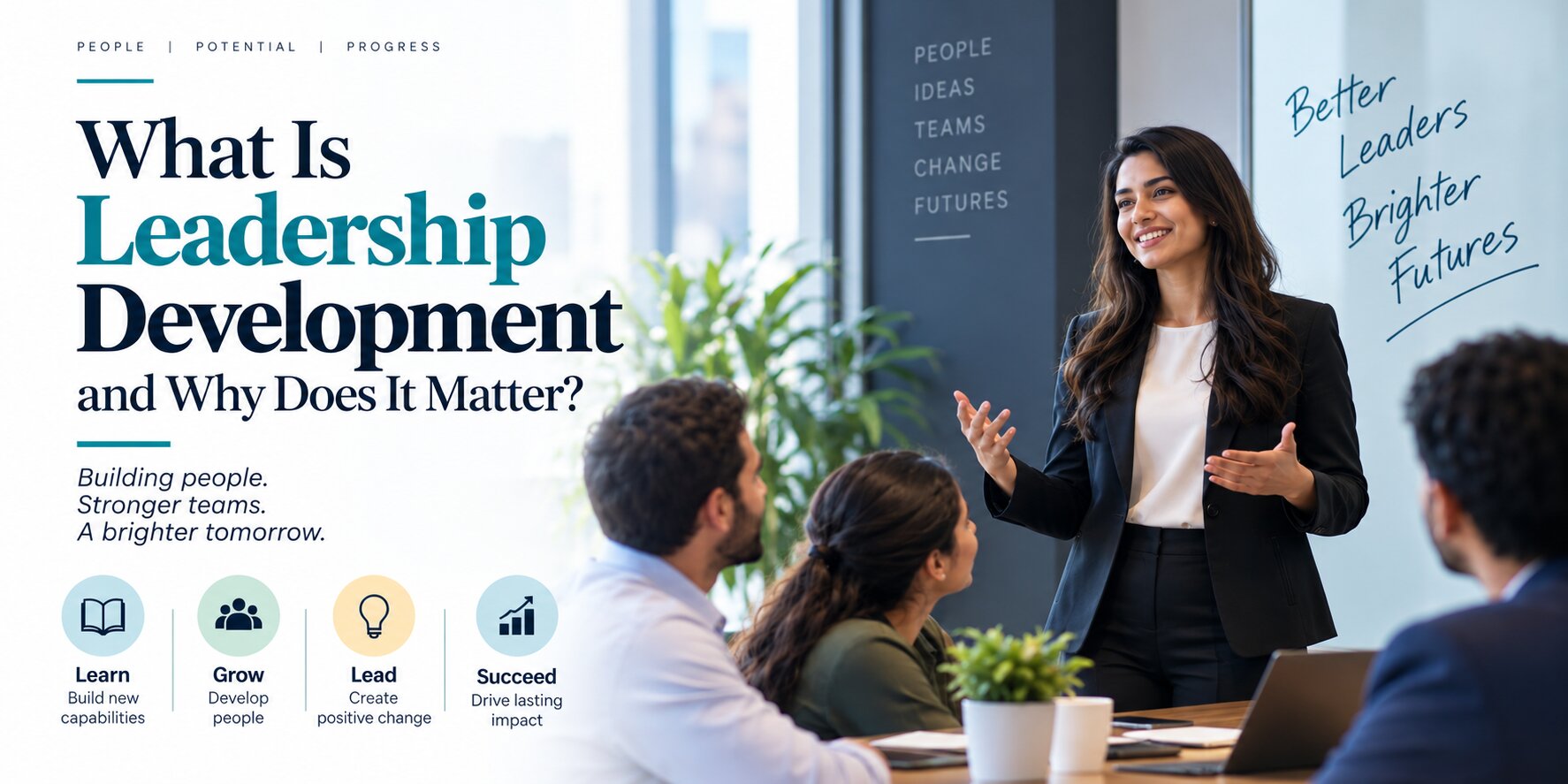
What Is Leadership Development and Why Does It Matter?
A person can be excellent at their job and still struggle when they become responsible for leading others. Managing deadlines, making decisions, handling disagreements, giving feedback, and keeping a team motivated require a different set of capabilities. This is where leadership development becomes important.
At its core, what is leadership development comes down to one idea: helping people become more capable and effective leaders through continuous learning, practical experience, feedback, and self-awareness. It is not limited to senior executives. Team leaders, managers, emerging leaders, and high-potential employees can all benefit from developing stronger leadership capabilities.
For organizations, the goal is not simply to create better managers. It is to build leaders who can make sound decisions, develop people, navigate change, and contribute to long-term business performance.
What Is Leadership Development?
What is leadership development in practical terms? It is the structured process of improving the capabilities that enable a person to lead people and influence outcomes effectively.
Leadership development can involve:
- Leadership training and structured learning
- Executive or management coaching
- Mentoring and peer learning
- Feedback and behavioural assessments
- Real-world leadership assignments
- Problem-solving and decision-making exercises
- Reflection and self-development
- Opportunities to lead projects or teams
The important point is that leadership development is not just classroom learning. Leadership skills become meaningful when people can apply them in real workplace situations.
For example, knowing how to give constructive feedback is useful, but the real development happens when a manager uses that skill during a difficult performance conversation and learns from the outcome.
Leadership Development Meaning: More Than Becoming a Manager
The leadership development meaning is often misunderstood. Some organizations treat leadership development as something that happens only after an employee gets promoted into management.
That approach is too narrow.
Leadership is about behaviour and influence, not just job titles. An employee can demonstrate leadership by taking ownership of a difficult project, helping colleagues solve problems, communicating clearly during uncertainty, or influencing others toward a shared objective.
Modern leadership development therefore focuses on building capabilities before, during, and after a person moves into a formal leadership position.
Leadership development commonly focuses on:
- Communication
- Emotional intelligence
- Strategic thinking
- Decision-making
- Delegation
- Conflict management
- Coaching and mentoring
- Problem-solving
- Adaptability
- Accountability
These capabilities help leaders deal with the human and operational challenges that come with responsibility.
Why Is Leadership Development Important?
So, why is leadership development important for an organization?
Because leadership decisions directly affect how teams work.
A manager who communicates poorly can create confusion. A leader who avoids difficult conversations can allow performance problems to grow. A leader who never delegates can create dependency and burnout. On the other hand, a leader who sets clear expectations, listens carefully, develops employees, and takes responsibility can create a much healthier working environment.
Leadership development helps organizations address these gaps intentionally rather than expecting managers to figure everything out on their own.
It is particularly important when an organization is:
- Growing rapidly
- Promoting employees into management roles
- Preparing future leaders
- Going through organizational change
- Building stronger teams
- Improving employee engagement
- Expanding into new markets
- Experiencing leadership or performance gaps
Importance of Leadership Development in the Workplace
The importance of leadership development in the workplace becomes clearer when you consider how much influence managers have over everyday employee experiences.
Employees interact with leaders regularly. Their manager may influence how they understand their responsibilities, receive feedback, handle mistakes, develop their skills, and approach challenges.
Good leadership can create clarity and confidence. Poor leadership can create unnecessary stress, confusion, and disengagement.
Leadership development can help organizations improve:
- Communication
Leaders need to communicate expectations, priorities, changes, and feedback clearly. Strong communication reduces misunderstandings and helps teams stay aligned.
- Decision-making
Leaders regularly make decisions with incomplete information. Development can improve their ability to assess situations, consider alternatives, manage risks, and take responsibility for outcomes.
- Employee development
A strong leader does not simply assign tasks. They help employees understand their strengths, identify development areas, and prepare for greater responsibilities.
- Team performance
Clear goals, effective delegation, accountability, and constructive feedback can help teams work more effectively.
- Change management
When organizations introduce new systems, processes, structures, or strategies, leaders play a critical role in helping employees understand and adapt to the change.
Leadership Development Benefits
The leadership development benefits can extend beyond individual managers. When leadership capability improves across an organization, it can strengthen the overall talent pipeline and management culture.
Some of the key benefits include:
- Better communication between managers and employees
- Stronger decision-making
- More effective delegation
- Improved conflict management
- Greater accountability
- Stronger employee development
- Better succession readiness
- More consistent leadership behaviours
- Improved ability to manage change
- Stronger alignment between people and organizational goals
However, organizations should be realistic about these benefits. Simply sending managers to a leadership workshop will not automatically change their behaviour.
Development needs reinforcement through practice, coaching, feedback, and opportunities to apply new skills.
What Does Leadership Skills Development Involve?
Leadership skills development involves building a combination of interpersonal, strategic, and practical capabilities.
Some skills are particularly important because leaders use them repeatedly in everyday situations.
Communication and active listening
Leaders need to explain ideas clearly while also understanding what their employees are saying. Listening is especially important during disagreements, performance discussions, and periods of uncertainty.
Emotional intelligence
Leaders work with people who have different personalities, motivations, expectations, and reactions. Emotional intelligence helps leaders recognize emotions and respond thoughtfully rather than reacting impulsively.
Strategic thinking
Leaders need to understand the bigger picture. They should be able to connect everyday decisions with team objectives and broader organizational priorities.
Delegation
Trying to do everything personally is not effective leadership. Delegation allows leaders to distribute responsibility while giving employees opportunities to develop.
Conflict management
Disagreements are inevitable in workplaces. Leaders need to address conflicts early, understand different perspectives, and work toward practical solutions.
Coaching and feedback
Employees need more than instructions. Effective leaders help people understand what they are doing well, where they need improvement, and how they can develop.
How Can Leadership Development Be Made More Effective?
Leadership development works better when it is connected to real workplace challenges.
Instead of relying entirely on theoretical sessions, organizations can combine different methods:
- Assessments: Identify current strengths and development gaps.
- Coaching: Help leaders work through specific challenges.
- Mentoring: Provide access to experienced leadership perspectives.
- Practical assignments: Give developing leaders opportunities to apply new skills.
- Feedback: Show leaders how their behaviour is perceived by others.
- Reflection: Encourage leaders to examine decisions and outcomes.
- Continuous learning: Reinforce development instead of treating it as a one-time event.
This approach makes development more practical and increases the likelihood that new behaviours will become part of everyday leadership.
Why Leadership Development Is a Long-Term Process
Leadership capability does not develop overnight.
A manager may understand the principles of effective delegation today but still struggle to delegate effectively when facing pressure six months later. Behaviour changes through repeated practice and reinforcement.
That is why effective leadership development should be treated as an ongoing process.
Organizations should regularly ask:
- Are our leaders prepared for future business challenges?
- Do managers receive useful feedback?
- Are emerging leaders getting opportunities to lead?
- Do employees have confidence in their managers?
- Are leadership expectations clearly defined?
- Are we developing internal talent for future roles?
These questions help shift leadership development from an isolated HR activity to a broader organizational capability.
Final Thoughts
Leadership development matters because leadership directly influences people, teams, and organizational performance. Giving someone a managerial title does not automatically give them the skills needed to lead effectively.
The real purpose of leadership development is to help people become better at the difficult parts of leadership: communicating clearly, making decisions, handling conflict, developing others, managing change, and taking accountability.
At The People 1st, leadership development can be approached as a continuous capability-building journey rather than a one-time training event. Organizations that invest in developing leaders early and consistently are better positioned to build a strong internal leadership pipeline and respond to future challenges.
A well-structured Leadership Development Program can provide the framework for that journey, but lasting results come from what leaders practise, apply, and improve long after the learning session ends.